01.09.2026
Artificial Intelligence and Education: Transmitting Knowledge Without Replacing Personal Relationships
Artificial intelligence can become a magnificent tool for transmitting knowledge, provided that it is used in the service of the person and in accordance with the principles of the Rome Call for AI Ethics. However, the true educational act—accompanying, discerning, engaging in dialogue, and helping others to grow—can be fully carried out only through the personal relationship between educator and student.
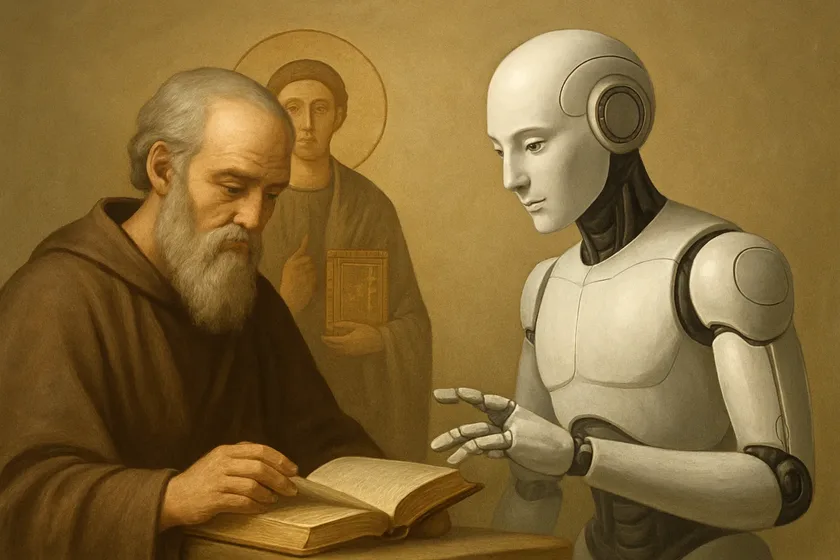
Artificial intelligence offers extraordinary possibilities for explaining concepts, adapting materials, facilitating access to information, and supporting learning processes. It can be a magnificent tool for the transmission of knowledge, but the transmission of information must not be confused with education.
For its use to be genuinely human, artificial intelligence must respect the principles of the Rome Call for AI Ethics. These principles are organized around three areas: ethics, education, and rights, and are expressed through six fundamental criteria:
- Transparency: artificial intelligence systems must be understandable and, to the extent possible, explainable.
- Inclusion: they must be designed so that all people can benefit from them, without discrimination.
- Responsibility: there must always be a person or institution responsible for the decisions and consequences of an AI system.
- Impartiality: artificial intelligence must not reproduce or generate unjust biases.
- Reliability: its results must be safe, consistent, and sufficiently rigorous for the use for which they are intended.
- Safety and privacy: systems must protect users and respect their personal data.
When applied to education, these principles require AI to serve as an aid to the teacher and the student, never as a substitute for the responsibility, judgment, or freedom of either one. Technology can provide answers, suggest paths, and expand learning opportunities; it cannot, however, establish a relationship of trust, recognize each person’s uniqueness, or provide human accompaniment as they make decisions.
The true educational act takes place in personal encounter. To educate means to help another person understand, think for themselves, and orient their life toward truth and goodness. For this reason, artificial intelligence must remain in its proper place: as an instrument at the service of an education centered on the person, sustained by the educator’s presence, dialogue, and accompaniment.
The university of the future will not be less human because it uses artificial intelligence; it will be more human if it knows how to use it responsibly without relinquishing the personal core of all education.