Seminar
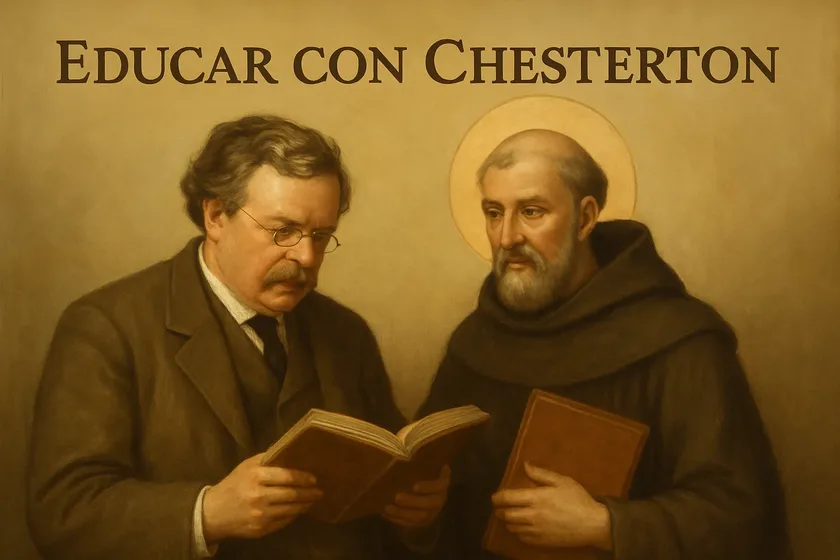
Educating with Chesterton
This seminar introduces G. K. Chesterton's ideas on the person, the family, the imagination, freedom, and the purpose…
View the course
Educating for a joyful encounter with Truth in the age of artificial intelligence.
Specialization
This seminar introduces G. K. Chesterton's ideas on the person, the family, the imagination, freedom, and the purpose…
View the course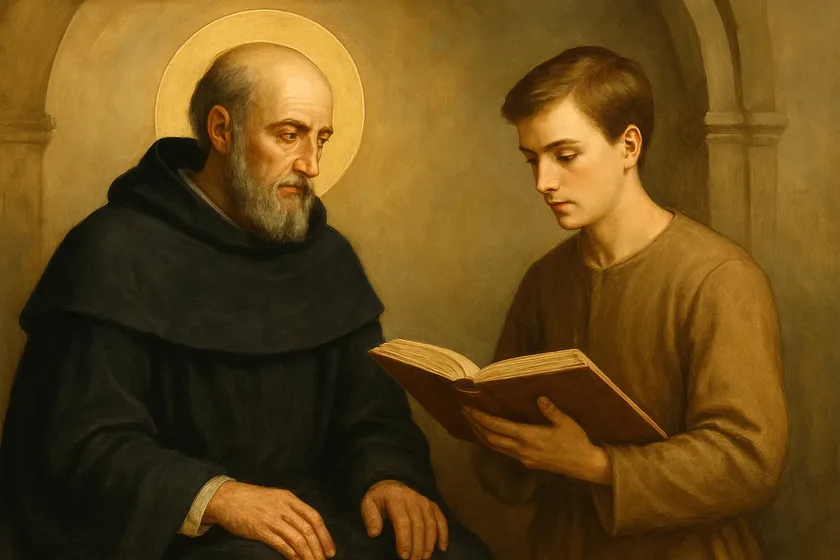
This course introduces teachers and educators at all levels to the Augustinian understanding of the interior teacher…
View the course
This seminar presents the conception of teaching in St. Thomas Aquinas based on Disputed Questions on Truth, question…
View the courseWhat sets us apart
Three things at once, and none of them ornamental: the learning path the university has been refining for eight hundred years, delivered as the brain learns and accompanied by an AI that never makes decisions on its own.
Tradition
Each session follows the eight phases of the Ratio Studiorum (plan of studies): the problem is posed, what came before is recalled, the matter is explained, an example is examined, objections are raised, the material is practiced, and everything is recapitulated.
Neuroscience
A forty-minute explanation delivered straight through is not retained, and we do not publish one here: the content is written in short segments with built-in pauses.
Artificial Intelligence
AI writes drafts, grades exercises, translates, and accompanies you. Anything that makes a decision about you is signed by a person.
Ratio Studiorum (plan of studies) - The method
At the medieval university, learning meant reading, raising objections, responding, and disputing. With the help of artificial intelligence, we are recovering that living and demanding learning path today in each of our sessions.
The eight phases of a typical UCA Guadalupe session:
Prooemiumwhy this session
It begins with a question you still do not know how to answer. It is the problem of the day, and it returns at the end.
Memoriawhat do I need to recall?
Before the new material, what you need to remember: the prerequisites and a review of something you studied a few days ago.
Praelectiowhat will I learn and why it matters
What you are going to learn and why it matters, with stops along the way to check that you are still with us.
Expositiothe master's explanation
The explanation. Never more than twenty minutes at a time without a break: attention cannot sustain more than that.
Exemplumsee to understand
A specific case. The abstract becomes understandable when you see it in action.
Quaestioquestion to understand
An objection, and you write your response before reading the author’s. Then you receive a response to what you have written.
Exercitationow you do it
Now you do it yourself. If you get stuck, the help increases step by step: the solution is the last step, not the first.
Recapitulatiowhat do I take away?
You write the session’s three ideas from memory. Only then does the opening question return.
Artificial Intelligence
At UCA Guadalupe, we use duly trained and fine-tuned artificial intelligence models to facilitate and personalize the learning process. We use it primarily to assist students, write drafts, create digital twins, dynamically grade exercises, translate, and accompany you as you study. We are telling you this here, before you enroll, out of transparency and because we believe you have the right to know.
How we use artificial intelligenceWhat AI proposes is validated by an instructor. Students will be able to communicate directly with human instructors whenever necessary.
A coordinator approves it, and the administration issues it. Artificial intelligence does not decide; decisions are made by people.
An instructor reviews, corrects, completes, and approves each lesson before it reaches you.
AI assists in the transmission of knowledge; true education takes place through a personal relationship with the instructor.
Faculty
Classes are taught by practicing professionals, not by a program. These are the people who teach in the open studies.
Holder
Pruebas
The Teacher According to Saint Thomas Aquinas · Educating with Chesterton · The Interior Teacher in Saint Augustine
Identity
UCA Guadalupe is recognized as a Catholic university by decree of the Archbishop of Toledo (Spain), with the favorable report of the Episcopal Subcommittee for Universities and Culture of the CEE. It is promoted by the private association of the faithful «Gaudium de veritate (joy of truth)», and the corresponding civil recognition is currently being processed.
Civil recognition before the relevant authorities is currently being processed.
Get to know the universityScope
The digital Catholic university UCA Guadalupe wants its educational offering to reach the whole world, overcoming cultural and language barriers. Since its founding, the campus and all its content have been translated and published in Spanish, English, and Chinese.
The School of TranslatorsArticles
Admission
Tell us what you would like to study. You do not need to have made up your mind: if you do not know where to start, that is what the conversation is for.
We tell you which course of study is right for you, how much work it really involves, and what degree you earn. No obligation.
You complete your enrolment and enter the campus that same day. There is no start date: each course of study begins when you do.
Before you decide
The programs offered by Universidad Católica Digital de Guadalupe lead to university-specific degrees, not official degrees recognized by Spain’s Ministry of Education.
No. You study remotely and at your own pace: you open the session when you can and leave it wherever you want; the campus remembers where you left off.
There are live classes, but they are an extra: those who do not attend do not miss anything, because the recording is added afterward in the same place the class occupied.
Each session lasts between 45 and 60 minutes, and when you finish it, the campus does not automatically move on to the next one: it stops and offers you the option to stop. The credits for each course of study reflect the actual work involved, not the hours of class.
It accompanies you: it answers questions in the lesson, discusses matters with you in the Disputatio (academic disputation), and corrects exercises so that you can learn from your mistakes. It is always clearly identified as such.
What it does not do is make decisions. No grade counts until a professor validates it, no lesson is published without a person approving it, and no degree is issued without human review by two people.
In Spanish, English, and Chinese. This is not merely an automatic translation layered on top: the content is translated and reviewed, and the Latin tradition is preserved with its equivalent alongside it.
The price of each course of study is based on its credits—that is, on the work it involves—and is listed on its information page. There is no separate enrolment fee or hidden cost.
That is exactly what it is designed for. There are no schedules or start dates, and the session is the unit of study: if you have an hour to spare, you have an entire session.
Tell us what you would like to study, and we will guide you with no obligation.
Request informationIf it’s just a standalone question, write to us and that’s it. A person will respond.
info@iacampus.es